Thursday, January 7, 2016

The Liebster Award

So the blog received a reward. Becky says thank you too...she's in the middle of something very important right now, so she'll chime in soon. As for me, here goes!

I was nominated by Chelsea of A Sartorial Statement, (who I have loved reading for awhile)...
And the 11 blogs I would like to nominate...

-Veronica at A Country Victorian. She is a fellow Michigander whose writing I adore.
-Have you met Kate at Mademoiselle Euphrasie? I love more than a few of her modern creations...
-Or what about Bygone Elegance? Her red and white 1890's bathing suit makes me green with envy!
-Isabella's sewing journey is incredibly inspirational at Isabella's Project Diary.
-Dixie Heartless at Heartlessly Handmade adds a little steampunk flair to her projects!
-The Dreaded Seamstress wins the title for best name! And also, her sewing.
-At Sewing and Sightseeing, Elizabeth does just that. A woman after my own heart!
-My Darling Dear and the Regency features historical lovelies by Abigael.
-Don't forget So Steady as She Sews. I love her writing voice!
-I just found the Calico Sisters. They're from Michigan! I feel a blogger conference coming on...
-And finally Dolly Creates. Because she has my Grandma's name and reminds me of her!

Here are the questions I'd like you all to answer:

1. When did the creative bug hit you? What sparked it?
2. Which has been your favorite project?
3. Which crafting skills would you like to learn, if time and money weren't an issue?
4. Looking back, what advice would you give yourself when you started your first big project?
5. How do you work through frustration?
6. Favorite time period to dress in-GO!
7. Which 3 tools are the most loved in your crafting room?
8. Who inspired you to start your hobby?
9. How have you grown as a blogger?
10. Tell us one of your little secrets about sewing.
11. Post a picture that tells the most about who you are. Tell why!

1. Where is your favorite place in the world?
That depends on my mood. On Tuesdays I like curling up on my friend Sue's couch talking. On Fridays it's the field of my indoor soccer league. Giggling with my goddaughter in my arms? Napping with my younger brother watching ice skating? But sometimes I need to travel...so this year, my favorite place in the world was the at the foot of the pyramid in Chichén Itzá


2. What has been your most challenging project, to date?
Sewing my first dress was ridiculous. I flew my sewing machine out to California while I visited my grandparents for a few weeks. It survived stuffed between bras and tennis shoes. I broke about 20 needles and my grandma's patience. Finally, I had a dress! It was that first hurdle, that project that I had never done before. After that, everything got easier!

Thank God for padded bras!

3. What do you like most do do on a rainy Saturday when nothing else is planned?
I'm a fan of an antique store road trip. By myself-it's a time for historical meditation! Then I'll stop by a sandwich shop and read a book. At that point my fiance will probably wonder where I'm at...I'm an extrovert that likes her alone time. Ambivert? Hanging out with my family is fun too. 

We're Michigan fans...

4. If you could travel to the past or the future, which would you choose?  How far in time would you go?
I would totally go back to Regency England and hang out with Jane Austen. Her voice is just so me. We would be buddies, I imagine. And we would sponge our sheer dress just like other ladies, because fashion is where it's at.

We'd get kicked out of every party

5. What is your favorite holiday tradition?  
Food. Anything food related is my absolute favorite. I have a healthy mix of Polish/German/Mexican ancestry, so my holidays are full of crazy different combinations. Turkey tacos? Check. Pierogis dripping with butter? Yep. Eating at 2 different Christmas celebrations in one day? Priceless.

Oh, and eating in 1865
Photo by Ken Giorlando

6. How do you motivate yourself when a particular project is difficult or tedious?
It really depends on the project. I still have a few tucked away, waiting to "age" properly. In terms of my jewelry, I often run into problems as to the materials I should use to achieve the most accurate reproduction possible. I'll set it on my desk and look at it for awhile. Then I'll put other things on my desk so it doesn't feel lonely. One day I'll accidentally knock a million beads on the ground, and it magically turns into art! In all seriousness, I'll do more research, ask for help, and set goals for when I want a project done. Little milestones help motivate me through bigger ones.


And then I make this face

7. Do you ever have a hard time explaining your hobby to strangers?  If so, how do you handle that?
Very few people in my life understand why I do this, my fiance included. He's the kind of guy who can build computers and fix sick people. I love him to the ends of the earth-but we're very different! As for strangers, I explain that I like history, camping, and dressing up. Usually people like one of those things, and we can go from there. I'm nerdy and proud.

My friends are strange too

8. What is your most invaluable tool?
My reading/writing skills are the most important tool in my box. I need to research a piece/dress, read directions, understand context, and eventually write about it later. I read very quickly, a skill that has had a very positive impact in my life, considering the hundreds of school books I've demolished.

My greatest asset

9. What is your dream project?  Time and money are no object - what do you make?
A reproduction Queen Elizabeth I dress. Like exactly from a painting, dripping with gems. Can someone also dye my hair? Give me a kingdom? *Sigh*

BAM

10. What is the last book you read?
I've been reading "doctor" books lately, ones that illustrate their struggles in medical school and beyond. I'm trying to better understand the lives of doctors since I will be marrying one! Also I have a bit of a morbid fascination; at a young age I watched horror movies and such. Stephen King is amazing! 


11. What is your biggest guilty pleasure?  (Food, TV show, clothing item, etc.) 

I should feel guilty about reality television, but I don't. Ghost shows, housewives, pampered rich people...is it so wrong that I'm amused? They're perfect, since I don't have to pay attention while I sew or create a piece. 

There you have it! And now to pass on the great Liebster Award to a few more of my favorite blogs...

Good Luck, and Good Writing!

~Kristen

Wednesday, December 16, 2015

Jane Austen's Birthday 2015

This year we celebrated dear Jane's 240th birthday at Bravo! Cucina Italiana in Livonia. In sharp contrast to my previous years, I had a friend and fellow JASNA member to attend with me!

Sue and I have been excited for this day ever since she joined JASNA this year. It was a delightful time! My camera did NOT like the restaurant's lighting, so I only have a few pictures. We chatted, ate too much food, played a little game, and sang Happy Birthday to our beloved writer. I always enjoy this event! Though it is usually colder...I only wore a shawl.

As some of my clothing recently shrank in the closet, I needed a new dress. What better way to honor my recently departed Grandma than to make a mourning gown? I had some fabric that was perfectly seasoned, so I worked to get it finished in a day. A long, needle-filled day. But it was finished!

After the luncheon we drove over to Greenmead to visit a few of our friends with the 17th Michigan. We were their "scandalous" grandmothers! There were guest tours around the village, but we came just at the end so we could hang out. Pictures ensued.
Where's the accidental anachronism?

It's these little moments when I get to spend time in history. I am so lucky to have them!


As of now I'm a little sick, so I'm hoping to stay on track with all of my writing. Christmas break is coming up, as is my birthday this Friday! And I maybe have one more awesome trip planned. As if I didn't travel enough this year...

~Kristen


Monday, December 14, 2015

Monday: Dwelling in Primary Sources

Lately I've had trouble focusing on what to do in terms of reenacting. It's been a hard year, and I've perhaps lost a bit of my passion. Between that and the many orders rolling into the shop, I don't seem to have time for the things I love-even if I've forgotten them!

Books used to be my bread and butter. Ask anyone-I would plow through a pile of pages. I once read one of the 600 page Harry Potter books, in its entirety, in a 24 hour period. Speed reading is fun, but sometimes I like to linger in words too, like that Emily Dickinson poem that's been on the tip of my tongue for over a decade. I read for pleasure before I read for school.

Academic reading-there it is! In my undergraduate degree I sailed through everything, from dark fiction to boring historical theory. My master's program was more difficult, but just as satisfying. I live for the art of research, the act of digging, my fingernails dirty with new words. 

Here is the problem. I've been told that many in the reenacting community refuse to read. The phrase "reenactors don't read" floats around conversations a bit too easily. I find that to be hilarious-so many  people I know read like I do. Ken Giorlando's library probably weighs enough to cave his floor in. Reading, or at least looking at primary sources, should be a priority for reenactors of any level.

I want to dwell in the text.

No, I totally did not come up with that. Vicki Burton, a professor of English at Oregon State University, definitely nailed my love of the written word in her article Ethos in the Archives. In it, she cites the root of the word "ethos" as "a dwelling place." And in Greek mythology, she follows the story of an impoverished philosopher, Heraclitus, that implores travelers to stay with him because "Here too the gods are present."

Burton asks how we imagine ourselves (particularly those in the field of rhetoric, but I apply this to researchers in general...) in terms of dwelling in the written word: "We embark on our research travels with high expectations. Then we arrive in the archives, and things are a bit of a mess—disorganized, uncatalogued, overwhelming. Like the traveling strangers, we are in danger of not seeing what is before us, of missing our chance to dwell. Here, too, the gods are present." She later notes the advice of a fellow researcher, telling her to "always assume that you must go back" to an archive. One trip is not enough.

Isn't 19th century source material such a mess? Magazines here, CDVs there, oh look a stray book! We force all of these concepts under umbrella phrases like "victorian" or "Civil War" in an attempt to make the overwhelming manageable. The mess into neat piles. But in those categories, as Burton says, we run the risk of no "seeing what is before us, or missing our chance to dwell." Even online sources are messy!

In terms of reenacting, research should be rooted in sources. All too often we hear of people asking a "knowledgable source," without reference to the primary documentation. Or worse yet, the illusion of proper evidence while completely ignoring context. We assume "experts" know everything, hanging on their every word. No. Using a quote or two to justify a piece of jewelry or dress is not dwelling in the text.

It is in this moment that I see my own faults. Sure, I am still keeping busy with research. But I don't stay long, only searching for what is most important. Quotes. Pictures. Bits of evidence for my jewelry. Materials and motifs are my launch pad; I need to go further. Hence my own personal challenge.

Every Monday, I will write a post rooted in the text. Spend some time playing with words or sources. I don't want this to be my typical "Materials and Motifs," which I so lovingly made popular as of last year (though I'll still be doing those too!). Here are a few of my specifications:

1. The post must include at least 1 piece of primary documentation.
2. There needs to be at least one visual image to help illustrate my point.
3. I need to collaborate with at least one other person (reenacting and otherwise) to help analyze.
4. The bibliography must include 5 other sources
5. My post must end with a question for further research.

I believe that this practice will improve my research, as well as my writing skills. Collaboration with other people will expand perspective. And am I naive to think I can inspire other reenactors to spend more time on the written word? To go beyond the simple petticoat, and into the fabric of history?

While this is technically my first "dwelling" post, I'm not going to evaluate a source. I tell my students constantly to plan and organize before they write. This initial post is a brainstorm, a beginning. The warm up! I'm also going to name it "Dwelling in the Source." Because I said so. However I will begin this post with a question...

How do I want to grow as a researcher?

~Kristen

Sources
Burton, Vicki. "Ethos in the Archives." Rhetoric Review 30.2 (2011): 109-34. Print.
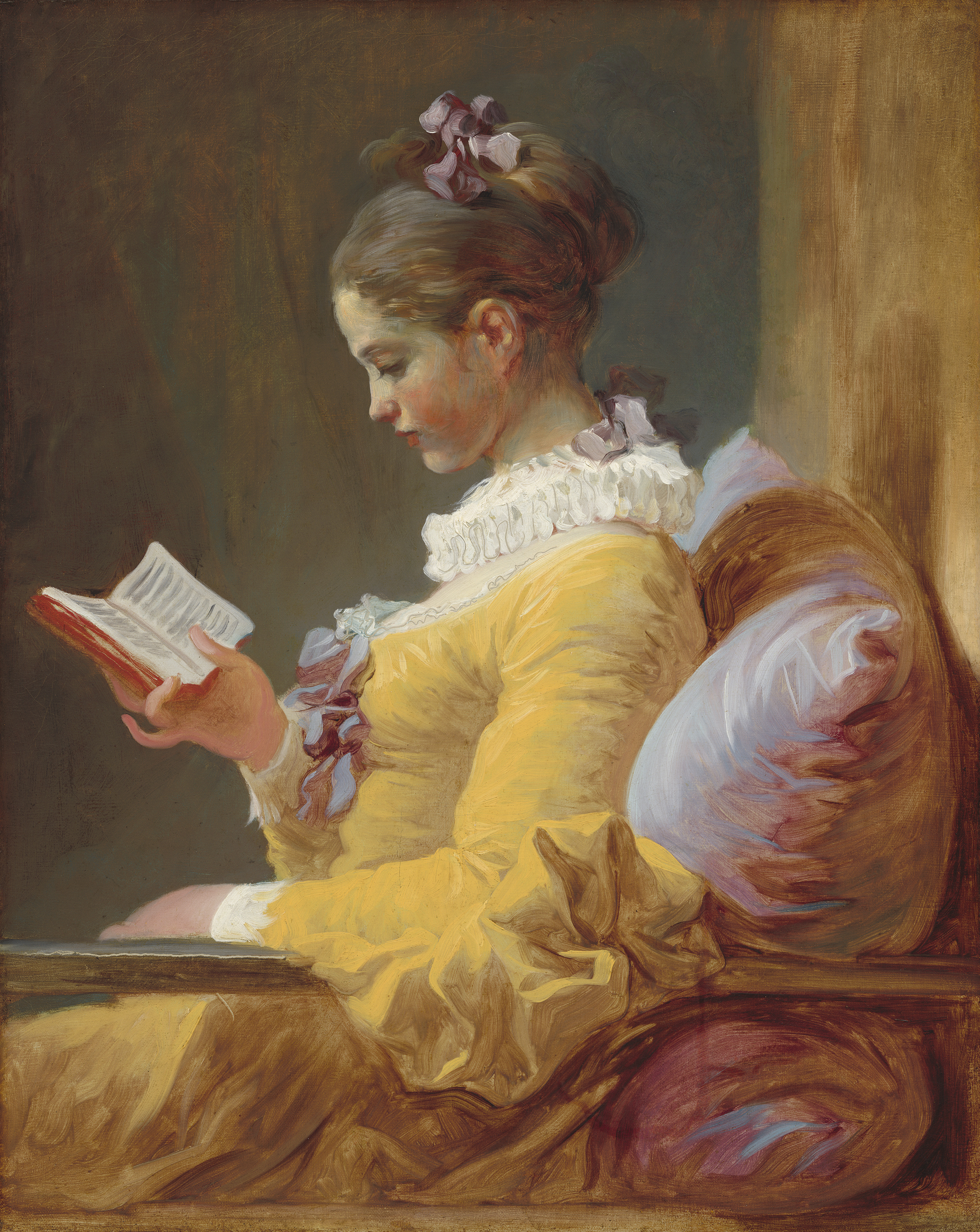
Fragonard, Jean-Honoré. A Young Girl Reading. 1770. National Gallery of Art. Wikipedia.
Hennig, Gustav A.. Lesendes Mädchen, um 1828. 1828. Wikipedia.

Tuesday, December 8, 2015

19th Century Motif: Butterflies

I feel like butterflies in 19th century fashion are the most secretly anachronistic style. Maybe someone from the 90's traveled back in time to drop them off to the adoring Victorian lady?

When I heard about butterflies as a motif, it was in terms of fabric. I didn't even consider them in jewelry. Over the past year this blog has featured skulls, snakes, arrows...butterflies don't surprise me. They actually start to make sense when thinking about the naturalistic themes. Also, they're pretty. I will like things if they are pretty enough...

History
Well, butterflies are bugs. Insects, to be exact. They've been around for at least 65 million years. I'm not going to science talk about butterflies, since you can read about that here on Wikipedia. In terms of ancient Greek mythology, Psykhe, the goddess of the soul, was represented as a butterfly. With the love of all those ancient Greek/Roman motifs, Psykhe "flew" into the hearts of Victorian ladies.

People of the 19th century often chased butterflies, collecting them for preservation in glasses cases. Magazines of the time period sometimes published plans for how to keep the winsome creatures. I'm not going to lie-I want one. 

The Butterfly Vivarium, Godey's Lady's Book, 1859

Ladies especially took the butterfly to fashion. Dresses, shoes, accessories, oh my! One can now see the origins of the butterfly bow in magazines and photographs alike. They are dainty little things. 

The Ladies Companion and Monthly Magazine, 1861

                                                             The Butterfly Rosette, Godey's Lady's Book, 1861

With the many crafts/pictures, I began to trail the path of butterflies in jewelry. Sure they are real creatures, printed or stamped or stitched. Now for the real question...are they used in the context of jewelry during this time period? Hint: Yes, or this post would be shorter...

***For more information about butterflies as motif throughout the 19th century (before and after the Civil War, check out Art of Mourning and their good article on the subject!)


Photographic Evidence
I'm surprised to have found butterflies at all. They're small and delicate; it's no wonder they're hard to spot. And the examples I have found are all postwar. 


Based on the other evidence I collected, the trend for butterflies as hair pieces or jewelry stayed popular throughout the mid to late 19th century.  As always, I will keep my eyes peeled for more of this type of evidence. 

Textual Documentation
Algerine Bracelet, Godey's Lady's Book, 1855
Materials.— Gold Bourdon 8 yards, gold thread and extremely fine ditto (mi-fin), cerise, or blue embroidery chenille, and 8 gold buttons.

THE bracelet is in two parts; the piece which goes round the wrist, and the butterfly -like ornament in the centre. Draw on white paper a braiding pattern according to the design; tack down the bourdon on it, taking the stitches across and never through it. To make the paper more substantial, it may be lined with a piece of toile-cire. Thread a long needle with the fine gold thread, and proceed to edge the bourdon with the coarse gold thread on one side, and the fine on the other. The thread is put on plain, but the chenille is formed into little loops, nearly close together. They are attached to the
bourdon by a sort of darning backwards and forwards. Pass your needle over the bourdon, and under the gold thread; let it go round the gold thread, under the bourdon, and through a little loop of chenille. Then again over the bourdon, and under the gold thread. It need not be done very closely; but when one part of the bourdon crosses another, take a few stitches across both to secure them. Sometimes the chenille and gold thread must change places, as the former is always to form the outer edge of the bracelet. The ornament for the centre must be worked in just the same way, and then attached to the bracelet. Two buttons are placed there, and two to fasten the wrist.

Fashions for July, Godey's Lady's Book, 1861
Among the extravagances invented by Parisian taste, but not as yet adopted to any great extent on this side of the water, are buttons composed of jewels or precious stones; such, for instance, as emeralds, turquoises, diamonds, pearls, and sapphires. Some buttons are made in the form of a small rosette or a tie set with jewels of different colors; others are shaped as a butterfly , the body being in white enamel, the wings in sapphire, and the head in rubies. 


Bridal Finery, Godey's Lady's Book, December 1861
The articles in wear for so long a time have been added to this fall—notwithstanding the pressure of the times, and the economical resolves of most families. Among them we note the rich combs of coral, ivory, silver, and gold, intended for evening wear, in full dress. To accommodate the new styles of wearing the hair, some of these have a hinged back, that is, the back of the comb opens to allow the heavy puff of hair to pass through, and closes into shape again. Jewelled pendants, to be attached to the headdress, is also another novelty; these are in various designs, as, for instance, a burnished butterfly , quivering on its perch, a fine spiral wire: there are leaves, crosses,etc., all very striking in their effect, when velvet forms the background.

Fashions for April, Godey's Lady's Book, 1862
Another was of Dunstable straw, faced with a sea-green velvet, and having two bands of the velvet on the outside, one standing up on the edge of the bonnet, and the other about an inch further back. This bonnet was trimmed with a black veil of spotted lace, about ten inches wide and three—quarters of a yard long; it formed part of the inside trimming, then turned over on the outside of the bonnet, and was caught by an exquisite branch of roses and buds on the left side near the edge of the bonnet; it was then folded over once, and carried straight down to the crown, where was placed a black butterfly ; the veil covered part of the crown, and fell over and below the cape, to which it was attached by a rose and bud. 

Fashions for August, Godey's Lady's Book, 1862
 A very simple headdress was a plait of scarlet velvet, with a very beautiful black and gold butterfly placed on the centre of the forehead.

A Glance at the London International Exhibition, Godey's Lady's Book, 1862
Passing over a fine suite of opals and diamonds, for such things become almost common in our eyes when we have spent half an hour in the jewelry department, we may particularly refer to an effective diamond and pearl bracelet, with butterfly clasp— the centre, pearl, with diamond and emerald wings— and to the examples here put forth of Mr. Emanuel's spécialite ornaments, made in a kind of pink ivory and gold, inlaid with different gems.

Fashions for April, Godey's Lady's Book, 1863
A very stylish headdress was of white feathers, with a bow of Azurline blue velvet, on which a butterfly was beautifully poised.

Fashions for May, Godey's Lady's Book, 1863
For coiffures, the humming-bird alone disputes with the butterfly the favor of fashion. These ornaments wore introduced by the Empress of the French, and bring fabulous prices, many of them being made of precious stones, or of enamel worked with gold. They are worn by young ladies as well as matrons; the humming birds, being the natural bird of the rarest plumage, frequently set with diamond eyes.
At a recent ball the dress of the Empress was hooked up with diamond butterflies . The coiffure was composed of tufts of violets, from which a brilliant diamond butterfly seemed ready to spring into the air. The natural butterfly is however a coveted headdress, and as it is extremely fragile, it is rather an expensive fashion.

Frank Leslie's Monthly, 1864

Fashions for January, Godey's Lady's Book, 1864
Then, again, we have the beautiful butterfly , sparkling with the most costly jewels (formerly the emblem of the soul, but now, alas! the emblem of coquetry and frivolity), arranged as ear-rings and pin, or glittering in the classical coiffures.

Arthur's Home Magazine 1864

Novelties for April, Godey's Lady's Book, 1864

Fig. 3.—A black velvet headdress, with gold ornaments; a mother-of-pearl butterfly at the side; a tuft of marabout feathers spangled with mother-of-pearl in front.

Peterson's, 1864

Petersons, 1865

With over a dozen reference to butterflies as hair adornment/jewelry, I can say that textual documentation is my strongest source. I left a few out too, since they were starting to get repetitive. The butterfly motif is listed in necklaces, earrings, bracelets, headdress pieces. I found gold, emerald, pearl, diamond, cut steel, black?, and beads. The surviving originals will relay a greater variety of materials, but I am happy to see the different types available just in print alone.

Surviving Originals

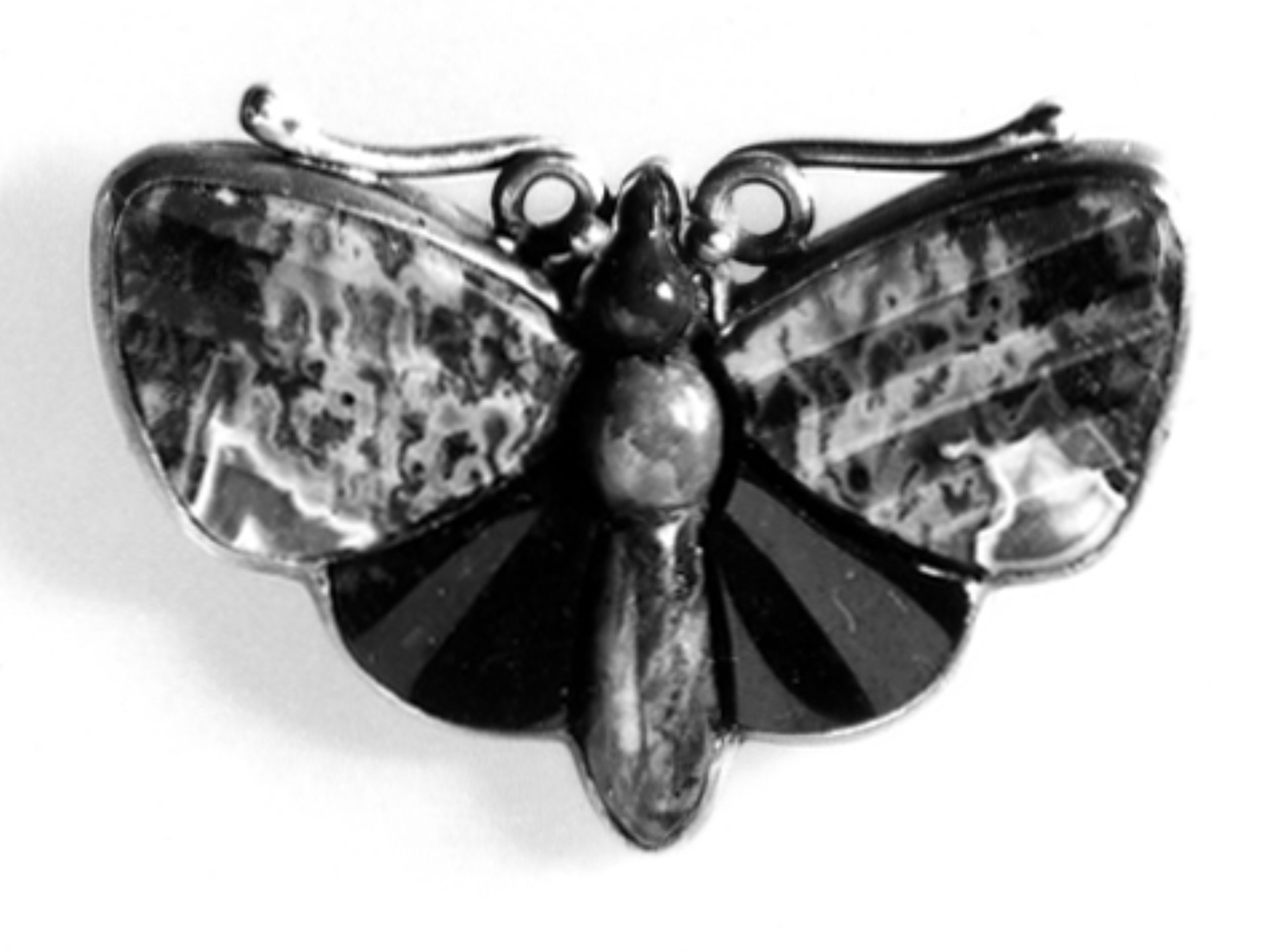
With the exception of a few known jewelers/materials, I can see why it would be incredibly difficult to date a butterfly. The shape varies so drastically, and the materials are all fairly similar throughout the 19th century. However, we do find a few new mediums-agate, hair, agate, and jet to start. The heartier materials seemed to have survived time, while I imagine the beaded butterflies on thin wire fell apart after a few years. Together with the photographic evidence and textual documentation, I believe I have proven both the popularity and versatility of the butterfly as a 19th century motif. 

In Conclusion...
Butterflies are thing. While I am not the first person to note that for Civil War reenacting, I'd like to think I've added the first spread of documentation for the motif as jewelry. Give credit to my bleary eyes and numb fingers...research takes a long time! 

In terms of context, I imagine butterflies mostly in headdresses or bonnets, with a few nicer pieces with a silk dress. One wouldn't wear a paste diamond butterfly brooch while bending over a campfire! I'd consider the butterfly as "fancy," or for a ball gown. If on a bonnet, probably beaded or handmade.

I'm developing different pieces as of now, by my pride and joy is currently in the tutorial I developed. While not an exact replica, it is an easy beaded tutorial if you wish to add a small adornment to a headdress or bonnet. Will I add them to my shop? Maybe? I'm still too busy playing with beads to do much typing these days!


Until time flies again (haha)...

~Kristen

Friday, December 4, 2015

Beaded Butterfly Tutorial

I've just completed my research about butterflies. I was going to put them together...but it was a lot of information on one post. So I've chopped them up. I will link to the Butterfly Research so you can see my inspiration and documentation. Let's begin!

Materials: 
Needle nose pliers
Clipper/scissors
Size 11 seed beads/cut steel beads
Size .25mm wire
Lot's of patience

1. Gather resources

2. Loop first bead on about 8 inches of wire


3. Keep feeding wire through, adding beads

4. Add 8 beads total. Leave the top wire alone.

5. Push an 8 inch wire through the bottom bead. Add 6 beads on each side

6. Pull wires through the 3rd bead to create a loop and leftover wire on each side.

7. Add 15 beads to each wire and pull through 7th bead.

8. Loop leftover wire through 8th bead.

9. Use this same process of loop from each side to add beads to the center.

10. Get creative! Add different colors on the inside/outside to make it look more 
realistic. Take care with the wire, as it is very thin and can break easily.
 Be patient-I broke about 5 of these before I got it right!


While these are not exact replicas of surviving originals, they seemed to fit best in terms of durability and aesthetic. Plus, they were easier than most tutorials I found online! Based on my research, these can be stitched right onto the flowers of bonnets. Or attached to combs. I might add one of these to my shop when I'm feeling especially creative. As of now, I think my eyes and fingers need a rest! If you do end up making one and improving upon my design, please leave a comment so I can learn/be jealous. 

~Kristen

On My Bookshelf: December

December has been a really rough month. Between what happened in Oxford (not far from where I live...) and just the general pandemic issues,...