I also love the color "tree"
Time and again coral surfaces in my search for accurate jewelry. Both the 18th and 19th century used coral in its adornments. I've worn a few pieces with my Regency dress, and more than often with my Civil War garb. They sell like hotcakes in my shop (seconded only by onyx/black stones) so I thought I would contribute my research for posterity. There are SO many sources to justify the use of coral that I will try to show the different sizes/shapes/colors appropriate for Civil War.
About Coral
Mostly found in the Mediterranean Sea, coral grows 4-100 meters from the surface. It is composed mostly of calcium carbonate, colored red by carotenoid pigments (Wiki). The stone must be polished, as it usually matte-colored. Control of the areas from which coral could be mined often led to fierce competition between different countries, especially in the 18th and 19th centuries.


The deeper meaning of coral leads back to ancient Romans. The story of Perseus, the sea monster, tells that coral the petrified seaweed covered in the blood of Medusa's head. Poseidon used the stone in his palace as well, making coral a prominent component of mythology. The Romans believed in the luck of coral, a sentiment revived by the Victorian era. Children often wore the stone, with the belief that it could cure snake bites or poison.

The Etruscan revival in the 19th century brought coral front and center in jewelry, especially from 1845 Italy. Honestly, it had not gone anywhere; the Georgian and Regency eras show a propensity towards the stone that cannot be missed in paintings. Dark reds and pale pinks were most common, even a dyed white coral was not remiss. "But even more prized were ornamented of finely carved coral, in the shape of crosses, roses, hands, cameos, and the like" (Flower and Moore). A coral parure for a young lady would have been considered a prized gift!

Mining took place for centuries, depleting the coral reefs off of many continents. Today's scientists have seen the results of overfishing and pollution on these reefs, so many organizations have sprung up to protect these habitats. Coral mining is more regulated in parts of the world, preserving the underwater habitat of marine wildlife. Substitutes such as glass or dyed bamboo are becoming more common in the marketplace to take the place of actual coral.
The Etruscan revival in the 19th century brought coral front and center in jewelry, especially from 1845 Italy. Honestly, it had not gone anywhere; the Georgian and Regency eras show a propensity towards the stone that cannot be missed in paintings. Dark reds and pale pinks were most common, even a dyed white coral was not remiss. "But even more prized were ornamented of finely carved coral, in the shape of crosses, roses, hands, cameos, and the like" (Flower and Moore). A coral parure for a young lady would have been considered a prized gift!
Photographic Documentation
It would be incredibly difficult to "prove" that a lady is wearing coral from a photograph, as those colors are added later. What we're left with is the possibility that the red necklace is indeed coral. Or is the white necklace pearl? Or black? Since we cannot physically touch the jewelry, complete authentication is impossible. However, I will still include this type of evidence as it shows the common nature of coral (or the appearance of it) in the 19th century.


There aren't many pictures much past little girls and necklaces. I KNOW based on my other evidence that coral was quite popular for other ages too, so I wonder why I can't find more photographs of women wearing it, rather than girls? Did they just not color in their jewelry? Or is it because these are earlier images? Sometimes a piece of evidence leaves more questions than answers!
Textual Documentation
I have more evidence of this type than I know what to do with. In fact, my first experiences with coral were from a source that mentioned its stylish nature. Paintings, fashion plates, descriptions; all show coral to be a popular stone for this part of the 19th century! I narrowed my search to 1855-65.
DESCRIPTION OF STEEL FASHION-PLATE FOR DECEMBER, Godey's Lady's Book, December 1859


BOARDING-SCHOOL EVILS, Godey's Lady's Book. February, 1860.
We well know that there can be but one ruling passion, and as vanity and all that goes to feed it, dress and jewelry especially, is the besetting sin of a school-girl's life, we can but wonder at the blindness that ministers to it deliberately, instead of uprooting any weed of temptation from the path. The rivalries of dress, furniture, and equipage, that make up so much of our social life, begin in the school-room with Eliza's Christmas set of pink coral and Lucy's ill-gotten flounced silk— ill-gotten, since it was purchased with the sum that should have given her mother a comfortable shawl or the children their bird's-eye aprons.
NATURAL ORNAMENTS, Godey's Lady's Book. June, 1860.
“THE month of roses” reminds us how few ladies make use of the most charming of all ornaments for the hair and dress, natural flowers. They load themselves with impossible clusters of muslin roses and jessamine, with dangling pendants of glass and wax, called jet and coral by courtesy; they flash bugles and spangles into your eyes with every turn of the head, while the pendant wreaths of the Spiera Reevesi, and the graceful racemes of the laburnum and the “bleeding heart,” or the perfumed cups of the valley lily, are perishing, unnoticed, in the lawn and garden.
MARY GREY, Godey's Lady's Book, June, 1860
Florrie, too, looked very lovely, in her little white dress and coral armlets and necklace, her golden hair curling in little short ringlets all over her head, and her cheeks the color of a May rose.
CHITCHAT UPON NEW YORK AND PHILADELPHIA FASHIONS, FOR JULY, Godey's Lady's Book, July 1860
Dress for evening, of perfectly plain white grenadine. The under skirt has three flounces of moderate width; the upper one is perfectly plain. There is no pattern, no edge of any description, to the flounces, sleeves, or waist—the richness of the material obviates it— with the exception of a rich satin ribbon, also of plain white, which forms the heading of the
MISCELLANEOUS, Godey's Lady's Book. August, 1860.
ARTIFICIAL CORAL .— This may be employed for forming grottos and for similar ornamentation. To two drachms of vermilion add one ounce of resin, and melt them together. Have ready the branches or twigs peeled and dried, and paint them over with this mixture while hot. The twigs being covered, hold them over a gentle fire, turning them round till they are perfectly covered and smooth. White coral may also be made with white lead, and black with lampblack, mixed with resin. When irregular branches are required, the sprays of an old black thorn are best adapted for the purpose; and for regular branches the young shoots of the elm are most suitable. Cinders, stones, or any other materials may be dipped into the mixture, and made to assume the appearance of coral .
CHITCHAT UPON NEW YORK AND PHILADELPHIA FASHIONS, Godey's Lady's Book. September, 1860.
The headdress consists of a wreath of the foliage of the service tree, intermingled with festoons of coral beads.”
DESCRIPTION OF STEEL FASHION-PLATE FOR JULY,Godey's Lady's Book, July 1861

Fig.
BRIDAL FINERY. Godey's Lady's Book. December, 1861.
The articles in wear for so long a time have been added to this fall—notwithstanding the pressure of the times, and the economical resolves of most families. Among them we note the rich combs of coral, ivory, silver, and gold, intended for evening wear, in full dress.
A LADY'S GLANCE AT THE LONDON EXHIBITION, Godey's Lady's Book. March, 1863.
Very delicate to our modern ideas, though barbaric to those of the Greeks, as developed in the collection of M. Castellani, is a bracelet of the lightest pink coral cut into small lily-shaped cup-flowers, with gold stamen tipped with minute gems.
CHITCHAT UPON NEW YORK FASHIONS FOR SEPTEMBER, Godey's Lady's Book. September, 1864.
Bands of velvet are much worn round the throat. Some are ornamented with studs of precious stones, and, though reminding us somewhat of a dog-collar, they are pretty. Three or four yards of velvet or ribbon, tied round the throat and the ends falling at the back, continue to be worn by young ladies.
The newest hair nets are made of small shells or coral . They are very pretty and dressy.
The newest hair nets are made of small shells or coral . They are very pretty and dressy.

Le Bon Ton, March 1857


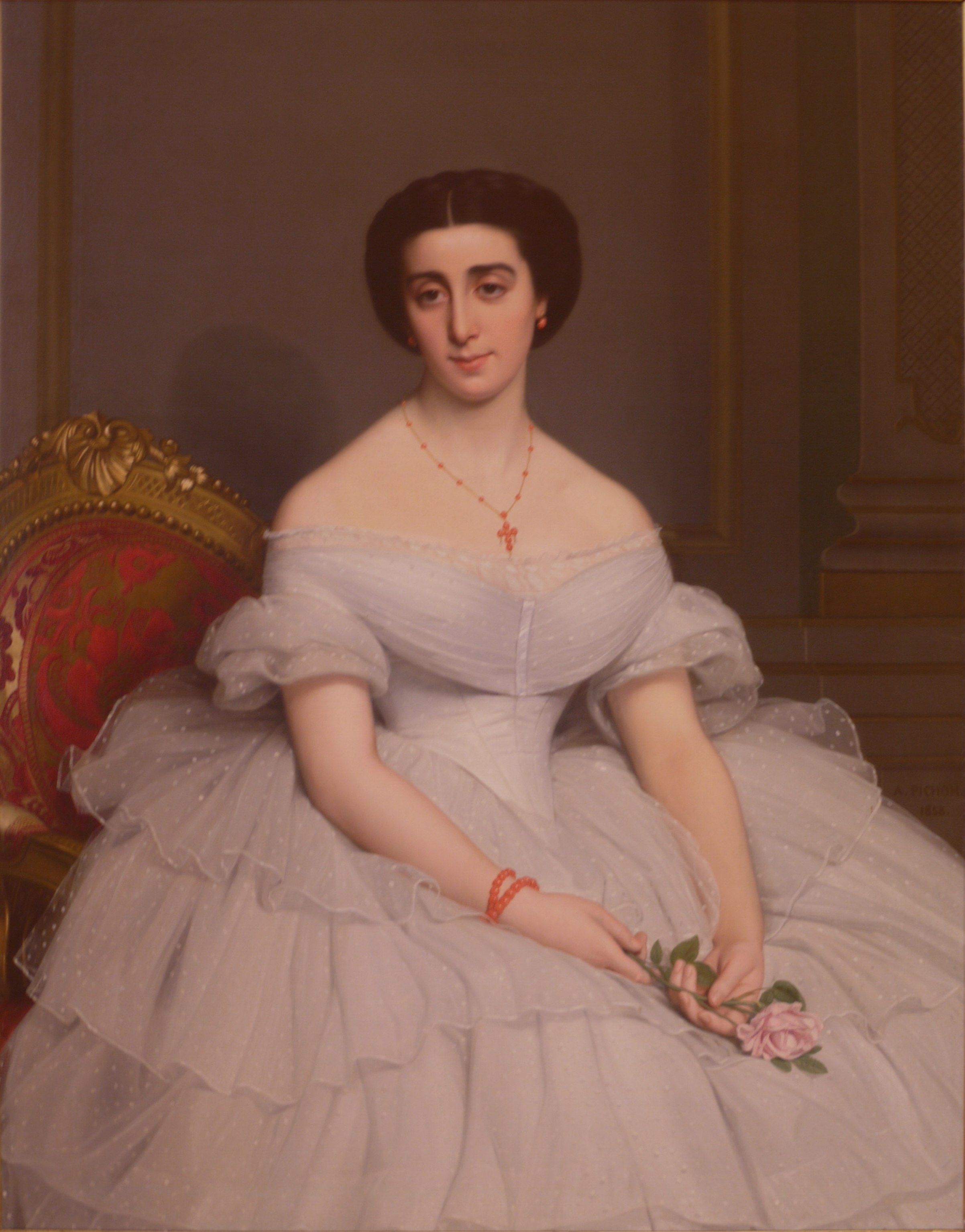

I had to stop there. I deleted many examples as I found them to be redundant. Basically, coral was used very often, and mostly by younger(ish) women. Yet I cannot find a reference that specially states it as "only" for young ladies. Perhaps its context and placement on the body depends on the age and status of the wearer? A debutante may have a coral parure that is passed down through the family, while her mother might have a single bracelet or pair of earrings. Just like today, people of different ages utilize the same materials, but in different ways!
Surviving Originals
This is perhaps my largest piece of evidence. The internet is jam-packed with awesome examples of coral throughout the centuries. These match up with the paintings and descriptions that I found in my textual documentation, only in tangible form. Don't you just want EVERY ONE OF THEM?


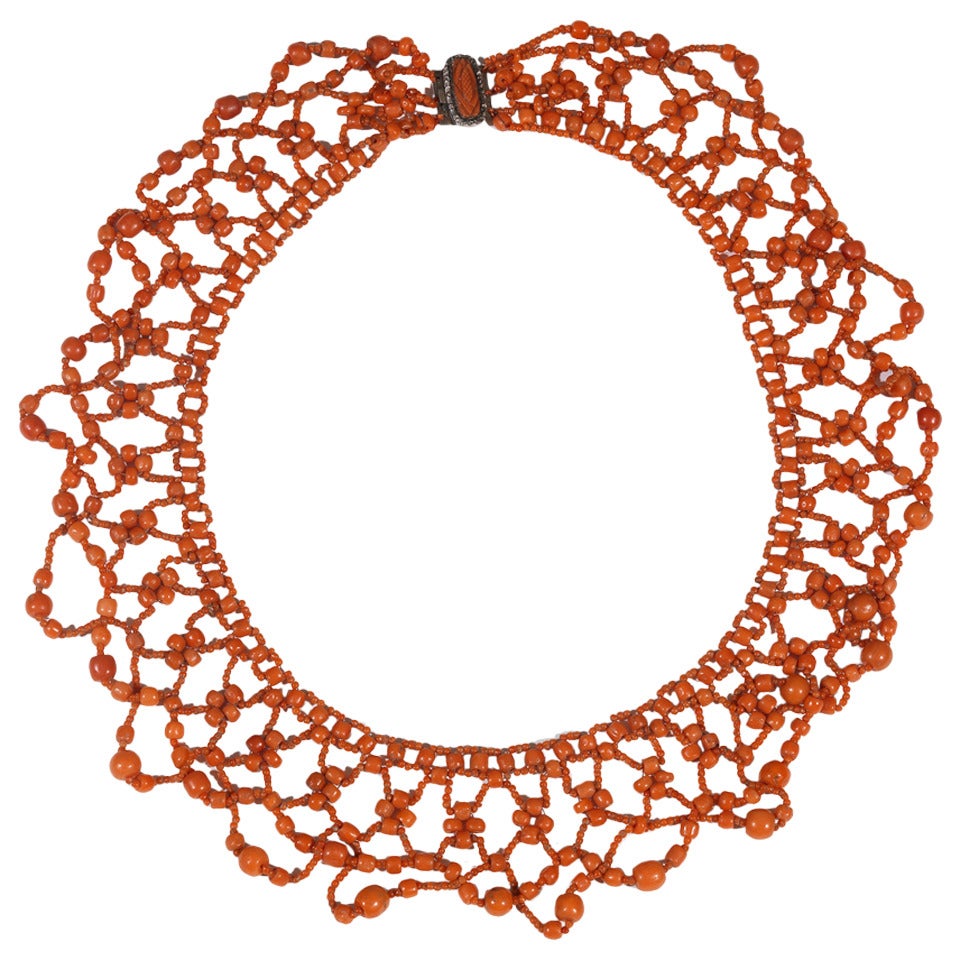


Note the many examples in so many mediums. Earrings, bracelets, necklaces, buttons, combs, parasol handles...oh my! Again I had a hard time narrowing down my results. I tried to find a variety of mediums as well as colors in which to view the style. One thing is for sure; there is a whole bunch of coral jewelry from the 19th century!
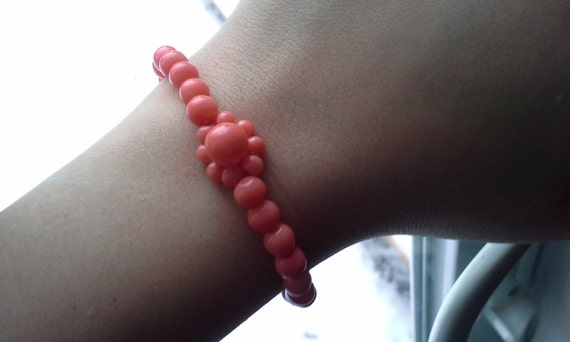
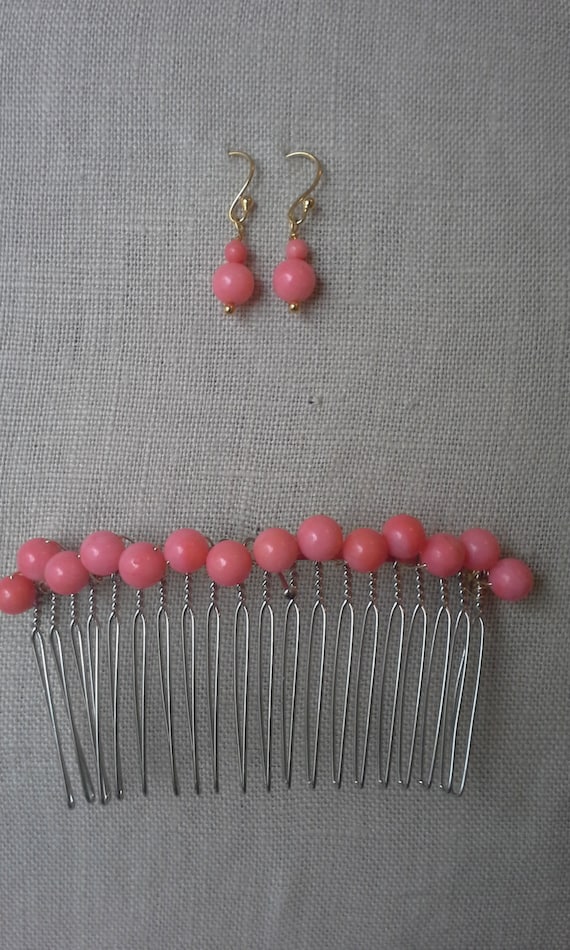
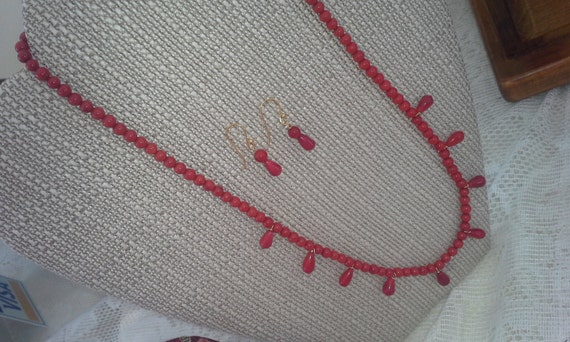


Note the many examples in so many mediums. Earrings, bracelets, necklaces, buttons, combs, parasol handles...oh my! Again I had a hard time narrowing down my results. I tried to find a variety of mediums as well as colors in which to view the style. One thing is for sure; there is a whole bunch of coral jewelry from the 19th century!
In Conclusion
Coral is amazing. Can I leave it at that? No? Well, my personal opinion is that more people should be wearing coral. And I'm not just saying that because I have a ton of it in my shop and I love making jewelry with it. I'm saying it because research.
As with my other motifs/materials, I think it is important to be aware of your surroundings before selecting coral as a jewelry piece. Are you cooking in a kitchen? Or going to a ball? The latter might be more appropriate for a full set of coral jewelry. A better day dress will suit a modest pair of earrings, while bracelets would be fashionable too. Young children are suited for coral as it keeps away bad luck, a daunting task at events with numerous fire-pits and changing weather. Red is just the prettiest color to see in a 19th century setting!
Did I mention Regency too?
Speaking of that setting, I would like to see more ladies wearing coral at appropriate events. Honestly, you don't even have to buy from me-there are other vendors that offer coral, such as Southern Serendipity and Originals by Kay. I will go back later to add more to this list to make it more of a resource. Again, I LOVE those coral adornments, and now you have the research to support wearing it so...if you must...go shopping!
May the odds be ever in your favor
~Kristen
Sources
Victorian Jewellery-Margaret Flower, Doris Langley-Levy Moore
http://www.gemsoul.com/coral-information
http://www.ecochicmagazine.co.uk/people-planet/biodiversity-people-planet/coral-mining-the-new-danger-for-reefs


.jpg)