Wednesday, November 13, 2019

The Domestic Skills Symposium 2019

Oh November. You have not disappointed yet, and we've only seen half of it. This year I again had the privilege of attending The Domestic Skills Symposium in Genesee, New York. GCVM is an amazing place, and this conference sets the tone for my entire holiday season. So wonderful learning mixed with a record-breaking snow storm?

Seems Reasonable.

My Mom accompanied me on the trip, which added a twist. Last year I traveled alone, and while I enjoyed the peace and quiet, it was nice to have someone to share the experience with. While my Mom claims she never liked history as a kid, she seemed to really enjoy the lectures. She especially liked the historic meals and asked about cooking from the original recipes.
Jennifer went too! And I wore cool hats

On Friday I taught a workshop on beaded dragonflies and butterflies. I created a handout with my research (primary sources yay!), and I brought out my own beaded collection of original 19th century butterflies. And to top it off, I was able to hold the conference in one of the historic houses in the village. It was a little chilly, but it felt so neat learning in a cool old house.
You can feel the history oozing off the walls

My students were very happy with the class, and mentioned they would like to see punch paper next year! Their creations were lovely, and they appreciated the research.I was impressed by how quickly they picked up the techniques. It was such a pleasant afternoon, beading away with other people just as excited about it as I am.

While I was teaching, my Mom sat at my table with my jewelry. I love having an audience who appreciates my research and whats to know more. My fellow vendors brought their A game as well; from hand spun fabric/thread and stitched mice to carved wood, I was in good company!
*Many of these photos by Jennifer Long-she's better at this than me!

 On Saturday we attended the main seminars of the conference. Here's the schedule:

"A Story in the Threads: The Clothing of Enslaved Women in the Antebellum South" by Cheyney McKnight, Public Historian and Proprietor of Not Your Momma's History.

"What's On The Table? An Exploration of Regional Shifts in Colonial Mid-Atlantic Foodways" by Lavada Nahon, Culinary Historian-Cook-Independent Scholar
"Stitching for Freedom: Quilts, Sewing Groups, and the Anti-Slavery Movement" by Judy Deyo, GCV&M Hand-Quilter and former educator.

"Upon These Shoulders: Speaking Truth to Power. The Freedom Fighters in Upstate New York." by David Shakes, Actor, Director, Producer and Historical Interpreter.
I had an opportunity to say hello to Cheyney again, as she spoke at The Citizen's Forum of the 1860's in March. This time I could actually sit and listen, rather than run around preparing things. The seminars were well-researched and thought-provoking. I was on the edge of my seat listening to David Shakes read poetry, while I have a few recipes from Lavada that I might try. Also, can I try quilting too? 

The meal was a master class of seasonings, spices, and tastes. A particular favorite at our table was the "Onion Pye," which featured boiled eggs, potatoes, and onions under a flaky pie crust. I was surprised by how delicious the fried celery was, though I suppose frying anything makes it taste awesome! And the "excellent rolls" were most excellent indeed. For dessert I especially liked the plum cake with whipped topping. Oh, and just a nibble of candied orange! What magic do they use to make this feast so good from year to year? We are so much I thought I would pop.


On Sunday I took a workshop on ribbon work. Many of the techniques I had tried in the past, but it was fun to learn new ones. I didn't finish many example pieces, so I took pictures of the instructor's ribbon to give myself an idea of future projects. Hair ribbons, anyone?

Probably the most crazy part of the conference was the visit to the collection. We went behind-the-scenes to examine original 19th century items in the museum and in storage. Brandon Brooks, L'Aspect Ancien, gave an EXCELLENT tour. He was not only knowledgeable, but made a point of connecting us to our points of research. A good teacher understands how to reach the students. He personally pulled items that had beadwork and we had thoughtful discussions about each piece. Even, my Mom, who had limited interest in historic research, was in awe of the tour. It has given me so many new ideas for projects that I can't function until I do at least one!


After an amazing few days, we planned to stay just a bit longer to check out Niagra Falls and visit a museum nearby. Instead, the Midwest decided to do what she does best; ruin our plans! At first they were predicting 1-3 inches for the day we were driving back through Canada (it's actually a shortcut). I had a feeling deep in my bones that it would be worse, so we left early and headed straight home. I am so glad we did this!

Looking at the map, I live in the dark purple range. Even this prediction was wrong; I measured more than 10 inches on my car. The drive was perilous at best, and we were lucky to have my Mom's truck for the duration. At a few points we survived by the skin of our teeth. Michigan, you confusing minx.

So I lived to blog another day. I came home to a raging storm, then a snow day on Tuesday. I'm still unpacking my bag and giving the puppy and kittens cuddles to make up for lost time. It was an amazing conference, a good time to catch up with friends, and the perfect way to start my holiday season. I hope you all stayed safe during the storm, and look for a post next week about Black Friday Shopping ideas!
~Kristen

Monday, October 28, 2019

Harvest Home 2019

Over the years I've come to humanize the earth and her seasons. I think of winter as a long nap with snow swirling about. Spring is a morning growl with flowers. And summer is very, very long day at the beach. In my mind, fall is tucking into a warm quilt while watching the leaves swirl about outside. A cup of tea is optional, but a good book is mandatory.

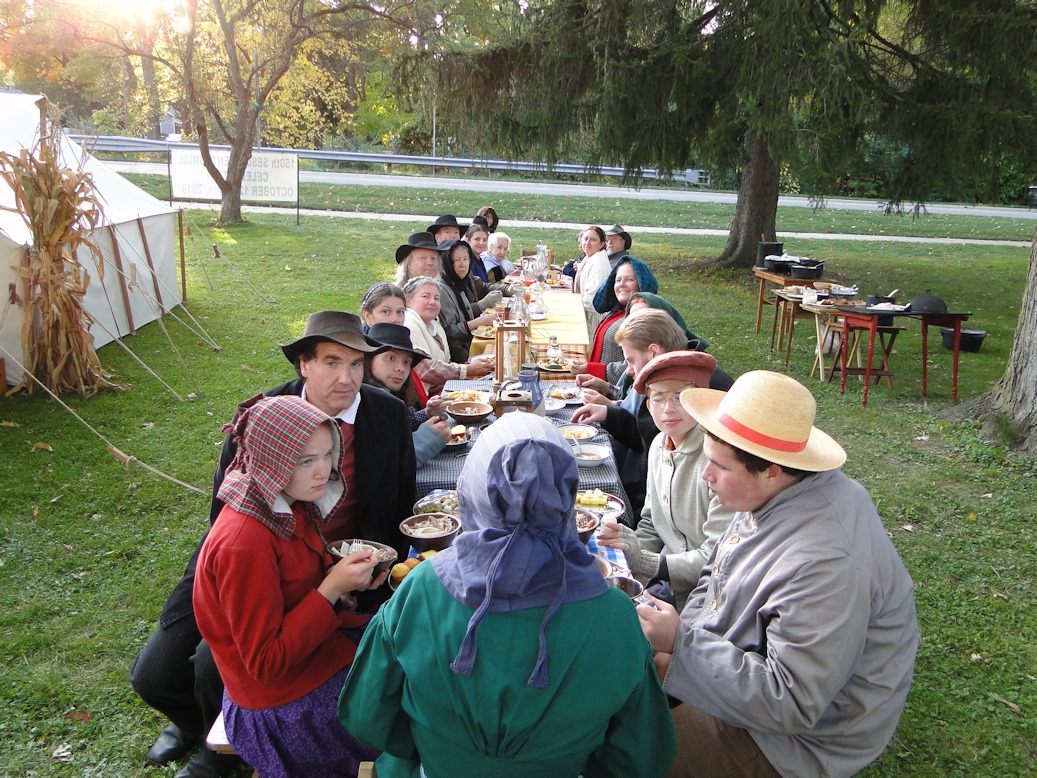
The 21st Michigan holds a Harvest Home event every year, and it certainly feels like a warm quilt of friendship gathered around! While it tends to have smaller attendance from reenactors, it is by far one of my favorites! Possibly because of the massive, cooked-over-the-fire feast that bring me to tears of joy every time. Folks, you haven't lived if you haven't had a fresh apple crisp straight from the fire.
I went up for seconds, thirds, fourths...you get the idea

One thing that makes this different from other events is that we make sure everyone has a specific impression related to the harvest. We had a cider press, cooking, canning, spinning, candle dipping, and even donut-making over the fire! Visitors to the Armada sesquicentennial downton stopped by out little encampment to see us hard at work. I was excited by how many people wanted to know more about history, including a gaggle of children who were very pumped about the cider press. And of course, those adorable little carved turnips!

For my own impression I went with something a little different. Instead of a schoolteacher or petulant daughter, I became a lady of the house tending to her herbal medicines. I purchased several original 19th century texts about herbs, including a copy of The Farmer's Almanac from 1860. While I did not try the recipes myself, I did research indigenous herbs to Michigan that were available in the mid 19th century. I asked visitors to identify the herbs I had in little bowls. Most could only guess one or two. White oak bark seemed to be the most difficult, though dill was a pretty easy guess.


Harvest Home is the perfect ending event of the year. We still have Christmas at Fort Wayne, but that certainly feels like winter. And in November I'm going to the Domestic Skills symposium in upstate NY, though it's not a 21st MI event. It was wonderful seeing my friends, eating good food, and making historical moments more visible to the public.
We are goofy if anything

I wish you all a warm quilt, cup of tea, and good book for your cozy autumn.

~Kristen

Wednesday, October 23, 2019

A Strenuous Education: The Young Ladies' Mentor

Education is a highly debated topic here in the United States. It was from the very beginning. Should we have a public education system? Who should teach? How should this system be organized. Today these questions and more linger, and as a teacher I usually have a front row seat to the debate.

Thomas Jefferson had his opinions about education as well:

"The article of discipline is the most difficult in American education. Premature ideas of independence, too little repressed by parents, beget a spirit of insubordination which is the great obstacle to science with us and a principal cause of its decay since the Revolution."—Thomas Jefferson to Thomas Cooper, 1822.

Not to contradict Mr. Jefferson, but I am a fan of insubordination now and then, especially when it serves a greater purpose for education. I'm always asking my students to question everything and to be independent. See? A debate in the making, with nearly 200 years separating us.

We both agree on the effectiveness of the "teacher glare."

After reading Eliza Leslie's The young ladies' Mentor or Extracts in prose and verse for the promotion of virtue and morality 1803, I find myself looking at a series of educational plans, a guide for educating a young person. The teacher in me finds threads, pieced together parts the mirror some of my own lessons. Except I think these lessons are good for girls AND boys.

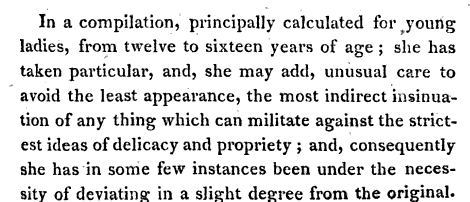
Sbe begins with a brief introduction about the purpose of the book, one that I can stand behind:

What follows is a compiled list of prose from different authors; it consists of 17 short stories, 12 poems, 18 miscellaneous pieces, and 15 poetical pieces (more poems).

The Settings
Teenagers, like any other age group, love to be entertained. While many of the stories focused on historical events, it was fantastic to see the different worlds depicted. The story of Mahoment provides a background for understanding the middle east, and Christopher Columbus' misguided but necessary adventures spanned the Americas. I was particularly fond of the descriptions of Sparta and the food of the past; nothing like a little broth, cheese, and wine to taste history!

To me, seeing these different settings in the compilation tells a youth that the world is BIG, and there's much to learn from different time periods and cultures. And while I imagine at least some young ladies groaned and pretended to listen, a few imagined worlds beyond the four walls of their house. I was one of those girls, and books like these kept that imagination alive!

The Characters
Joan of Arc is one of my favorites. Such a strong, faithful woman! In the story she more portrayed as a warrior, especially at her trial where: "Her behaviour there no way disgraced her former gallantry she betrayed neither weakness nor womanish submission." Eventually her spirit did break after cruel mistreatment by her captors, and she agreed to recant her belief that she was sent by god to lead the armies. She was considered a heretic for wearing men's apparel. The English offered mercy if she donned womens' clothing; at one point they tempted her with men's clothing, and when she put it on they declared it a relapse of the original charges of cross dressing. Then "She was executed with the most infamous severity."


While Joan of Arc is considered a strong female character, the story seems to emphasize the fact that stepping outside of the social boundaries of clothing seemed to be her downfall. It was perhaps more of an egregious charge than leading the armies of men to victory. There's a lesson to be learned from this character; a woman of faith and courage may persevere, but heaven forbid don't wear the wrong clothing! I could see at least one nodding mama pointing this story out to her daughter, admonishing her for a pair of dirty gloves or mud on her hem.

The Morals 
Oddly enough, I don't look to stories for my lessons on virtue and morality. I find poetry to be closer to the center of the soul. In Hay-Making, the preciousness of hard work in the field is presented: In order gay/While heard from dale to dale/Waking the breeze resounds the blended voice/Of happy labour love and social glee. I imagine at least one parent instructing her daughter that tidying up after herself is not the same labor as clearing a field! The lesson of hard work making happiness is evident here.

In Contentment, the author proposes a humble but happy existence. I Envy not the proud their wealth/ Their equipage and state/Give me but innocence and health/I ask not to be great. I've had this exact same discussion with my own parents; no you don't need to buy every little thing, your health and happiness is far more important. There was a 19th century parent doing this, I'm sure.

And finally, the most sobering lesson of all: youth is fleeting. As found in The Close of Spring: Ah poor humanity so frail so fair/Are the fond visions of thy early day/Till tyrant passion and corrosive care/Bid all thy fairy colours fade away. Because those young ladies, aged 12-16 years, for whom this book was written, would eventually grow up to be women. Those women would become wives, mothers, teachers, and suffer the loss of their youth. I recall my own mother saying this when I insisted that I wear mascara and lipstick in junior high school. "Kristen," she would say. "Youth is the prettiest makeup." To this day I still rarely wear makeup (that might have more to do with laziness?)

I have one edit to my mother's lesson: HAPPINESS is the prettiest makeup. 

Read Online:

Monday, September 30, 2019

The Citizen's Forum of the 1860s 2020

The Citizen's Forum of the 1860s 2020

This is our 4th conference!
Our second year in Maumee, Ohio
at the Wolcott Heritage Center

Take a look at what we have available this year, as we've added many more workshops. With twenty different workshops, there's a bit of something for everyone! There are also 4 seminars that are included with registration, as well as an awesome Friday night soiree, a bunch of vendors, and food/snacks available throughout the weekend.


Practical Diversions: The Early Art of Amusement


SEMINARS

​“The Never Tiring Amusement:” Visiting the Circus
~Clarissa Doak
Lions and tigers and acrobats, oh my! Prepare to be amused as Clarissa Doak, (list your title/certification) discusses her research about the history of the circus in the United States. Learn what people did, what they wore, and the societal expectations of those in attendance. Visitors beware; even pick pockets plied their trade alongside the performers! Primary sources will show that the traveling show was a popular pastime, one that shaped the modern perspective of performance art and entertainment. Threads from that history can still be seen in our amusements today.


The Mystery of the Groundskeeper: Recreating the Frank family in Revolutionary America
~Shirley L. Green PhD
My great-grandfather, Thomas Henry Franklin, was a well-known landscaper in his small community of Annapolis Royale, Nova Scotia. He passed down the oral tradition of the Franklin family to his sons--this information was passed down only through male members of the family and stated that the first member of the Franklin family came to America from Africa by way of Haiti. Two of his descendants—two freeborn brothers with the last name of Frank—fought together in the Rhode Island Regiments of the Continental Army during the Revolutionary War. By using genealogical and microhistorical research methods, I was able to document the journey taken by the Frank/Franklin family as they lived through the turbulent years of the American Revolution.

Pianos, Parlors, and Polkas- American Popular Music in the Home 
from 18th century through the 1860s
~Brian Shifflet
As is true today, music was an integral part of life through the 18th and 19th centuries in America. We know music was commonly played in the home and at social gatherings, but what types of music were played? And what types of instruments were used? This presentation will explore the everyday types of music played at parties, social gatherings, and evenings in the parlor with family and friends. Using research from primary sources, the Colonial Music Institute, and the Parlor Music Academy, the presentation will be a combination of lecture, performance, and some audience participation! In addition to the what, where, and why of popular song of the time, we will also discuss ways to use music as accurately as we are able in our impressions for various periods. The primary focus will be late 18th century, and mid-19th century (1840s-60s).

An Artistic Endeavor: Labels from the Civil War
~Bob Sullivan

For years, living historians and museum sites have tried to stock their shelves with products from the mid-nineteenth century in order to create a more accurate representation of history. Colorful labels have decorated shelves, attracting buyers with their symbols and images. Many colorful stories and legends have persisted about product labels. In this presentation, Bob Sullivan shows dozens of labels that are documented to the Civil War era, and will explore some of these myths and explain how to tell if the label is from the period or not.


WORKSHOPS

Utilizing Technology for Living History
***Free***
~Kristen Mrozek
The internet is an amazing tool that has so many uses for a museum or living history organization; posts on Facebook can advertise events, blog posts provide visual elements of history, while Youtube videos can truly bring an activity to life to anyone with a connection. Using technology impacts the way a group can communicate and effectively reach a larger audience. The workshop lead by Kristen Mrozek will offer guidance for using these resources to better serve your organization. Attendees will have the opportunity to review their or their/group's online profile and provide tips for reaching a wider audience. A laptop/tablet will be helpful to actively participate in this workshop.


The 18th Century Shift
$95
~Sara Gonzalez
Explore a nifty facet of mid-century publications: a range of small, useful projects to be made with commonly-found household materials, with only a small expected influx of readily-available purchased supplies. Get familiar with mid-19th-century "Pinterest", and make something of your own! Participants receive a short list of stash items to bring along for their projects or to swap with others; a Common Findings table with findings and materials is also open for use, and the workshop includes an illustrated take-home workbook with templates and instructions for each project. All projects are drawn from US publications 1859-1865.

Up Close and Personal Clothing
***Free***
~Glenna Jo Christen
Join Glenna Jo Christen for an in depth, interactive experience with the items on
display in our museum display in the Farmhouse. Go beyond static displays and photos and feel for yourself the difference between period cotton and wool fabric, look inside garments and accessories to see up close the hidden features and details and learn which are unique or typical for the era. Learn the context for who would wear or use different items and for what purpose. Take measurements of garments of specific interest to you. Feel free to bring your cameras, pencils and paper (no pens please).

Make Your Own Hardback Blank Book
$20
~Bob Sullivan
In this workshop you will be taught elements of book-binding and will make your own blank book.
You will learn proper sewing techniques for binding a stack of paper as a book, how to create a cover, attaching endpapers, and finalizing the book. The workshop includes a kit with all the materials necessary to make 1 blank book with 50 sheets of blank paper covered in marble paper and half-bound in cloth. Book covers made in this way can also be used as covers for phones, tablets, and other modern devices that find their way into camp.


1860’s Fabrics 101: Training the period eye
$5
~Sara Gonzalez
Have you ever wondered how to know if a fabric is period correct? Is it possible to go to a fabric store and just know if that cotton print is appropriate for the Civil War years or to throw it out the window with the rest? How do you determine these questions if it doesn’t say “reproduction?” What type of fabrics did they actually have and use frequently in the 1860’s? Get the answer to these questions and more in this brief lecture class by fabric enthusiast Sara Gonzalez, all while you pour over images of original textiles and discover their uses! This class is FREE to everyone to took this class in 2019. It has been updated with LOADS more information!


Circus Paper Toy Theatre
$30
~Kay Dodge
This workshop will teach participants about the popularity of paper toy theaters from 1830 until the 1870’s. We look at some beautiful images of antique theaters and discuss the various types that were available in the 1860’s. Participants will then construct their own reproduction paper toy theatre. All supplies will be included in the workshop fee to include circus toy theatre, adhesives, scissors, character wands, and any other supplies necessary to complete the project.

Victorian Hair Flower 1
​$35
~Lucy Cadwallader
Each participant will be shown how to construct their own hair flower using the "gimp" technique. Supplies will be available to complete a flower. If you elect to bring your own swatch of hair, it must be at least 10 inches in length and the diameter of a pencil-place in a zip lock bag. You may opt to make your hair flower into a boutonniere, displayed in a glass paper weight/shadow box or encased in a pendant. Please contact Lucy if you wish to purchase paper weight/shadow box or pendant, supplies are limited.

A Workshop @ the Soiree
***Free***
~Self Lead
Looking for an excuse to practice first person? The Wolcott House is the perfect opportunity! A special room in the house will be set aside for participants wishing to engage in polite conversation and experience authentic surroundings. Participants will be given information in advance to help prepare for a possible role. Games and other interactive items will be available on site.

Decorated Hairnets
$38
~Betsy Connolly Watkins
As demonstrated in countless original images, hairnets (both decorated and undecorated) were one of the most popular accessories for women of all ages in the mid-19th century. These functional bits of frippery kept the hair neat and tidy while also accessorizing the ensemble.

In this workshop, we will discuss hairnets and look at different examples of hairnets. Participants will have the chance to try their hand at creating a decorated hairnet using ribbons, beads, and tassels. Basic hand sewing skills are necessary to complete this workshop.

Youth Discussion 
***Free***
~Kristen Mrozek
Hey Young People! This is for you! We will return to the thoughtful discussion of youth in living history, and how we can attract even more young people. During this workshop, young people will communicate their perspective of living history while interested adults may quietly observe and take notes. In addition, young people will be asked to participate in a group project that visually represents their thoughts. As always, they will receive a book in the area of their interest to promote their future research.

Bonnet Veils
$15+, Nylon Net Kit $29.95 or Cotton Net Kit $65
~Kim Lynch
Have you noticed these lovely nets attached to bonnets? Bonnet veils were generally black lace in the shape of an orange wedge, worn with the straight edge draped over the front edge of the bonnet brim to hang evenly just below the wearer's chin. Veils served multiple functions depending on the situation; screening from the sun's glare and small flying insects an implied request for privacy when out on city streets or traveling on public transportation. In this workshop you will make a veil from a kit. Both nylon and cotton net kits are available.

"It Was a Dark and Stormy Night… Popular Reading of the Mid 19th Century
***Free***
~Glenna Jo Christen
A brief overview of popular literature of the era and the roles reading played in society, including who was reading what kinds of materials. This will be followed by a discussion of the value (and pitfalls) of reading what people of your chosen era were reading, for persona development and a unique and important source for learning about the social and material culture of the era.

Examples of original books will be available to learn what to look for in used book stores and antique stores to find books of your own to read.Participants will receive lists of the best and better sellers of the era for future reference. The lists include notations of books that are still in print.

​Toxicity in Reenacting
$5
~Amanda Fross ~Megan Reisener
Almost everyone has experienced toxicity within the living history community, especially with the rise of social media. This may have you asking if there is anything we can do to stop the cycle. This session will be separated in three parts. First, we will identify what specifically is toxic behavior within the community, second, we will brainstorm how we can positively combat these negative behaviors, and third, we will end the session with a round table discussion on specific experiences.


Wolcott House Tour
$5
~Museum Docent
Curious about the beautiful Wolcott House where we hold the workshops? The six buildings on site date to the 19th century, and contain significant importance when learning about the past. A museum docent will review the history about the people who lived in and used the spaces. This is a walking tour, so be prepared to go up and down stairs.

1860s Gymnastics 
$5
~Amanda Fross
Gymnastics was a new phenomenon in the 1860’s. Explore the history and fashion of this new form of exercise. At the end of the lecture, participants will receive instructions to try out different gymnastics exercises of the era.

The Spirits of Wolcott House
$5
~Museum Curator
There are many who have walked the halls of the Wolcott House and claimed that the past residents remain. They say that these everyday objects and spaces of the past swirl with energy. Join us as the museum curator guides a tour through the house at night, reliving these stories and legends. Every old house has a little history...but this historic site has a ton!

Men’s Basic 3 Button Shirt Workshop
​ Intermediate to Advance Sewers Only
$45
~Sandra Root
Learn to make a men's basic, 3 button shirt! This workshop will include an overview of men's shirts from 1850-1860's. An essential item in every man's wardrobe. You will learn to make a pattern and cut out the shirt using measurements, as well as insert arm gussets and neck plackets. There will also be instruction on proper buttons and buttonholes. Full written instructions for completing the shirt are included. Students may not have time to completely finish the shirt, but will have a full understanding on how to finish the construction.

19th Century Ladies' Drawers
$95
~Sara Gonzalez
Drawers are a necessary 19th century underpinning! In this workshop, we will be taking measurements and cutting out a set of period accurate 19th century drawers in your size, then work through construction. All instructions will be given to take home, in case you do not finish your drawers in class. An overview on extant drawers and recommendations on trimming them will also be shown.

The Perfect Hand-Sewn Buttonholes: Made easy!
$20
~Sara Gonzalez
Do you struggle with hand sewn buttonholes? Do you try with all your might, but they just don’t look good? Sara will unveil the secrets to hand-sewn buttonholes on a myriad of different fabric types and garment projects. Learn what you need to know to make the perfect hand sewn buttonholes in this crash course workshop! Hand-sewn buttonholes will help you “step up” your 18th AND 19th century garments!

Victorian Hair Flower & Wreath Construction 2 
$40
~Lucy Cadwallader
For those of you who have taken the beginner hair flower workshop-and feel comfortable weaving the gimp pattern-Lucy is offering an in depth class where a variety of hair flower techniques will be introduced....we will focus on the actual construction of a wreath. There will be Victorian wreaths on display for your viewing and also reproduction pieces to inspire your creativity!


Registration is still $110 for adults and $45 for youth. I recommend signing up early, as some of these classes have a limited amount of seats (10 or less). It also helps us plan better for a large group, and how many booklets to order. And I like knowing a number WAY far in advance :)

We hope you join us this year!

~Kristen

Wednesday, September 4, 2019

A Visiting Quack: Selections from Eliza Leslie

As of recently, I signed up for a reading challenge, one led by the formidable Anna, of If I Had My Own Blue Box. We will be reading different texts from Eliza Leslie, an author from the 19th century who published a series of texts with stories, recipes, patterns, and different parts of material culture. I'm excited to be a part of this study of history, as it's so important to jump deep into the primary sources.

This is the first of twelve posts!

A Visiting Quack: Selections from Eliza Leslie
Upon first reflection, the book appears to be one of those "womanly things," a primary source easily overlooked by people studying battles or famous nonsense. It has recipes, stories, and project ideas; it is easily compared with magazines from today. And if I weren't the crazy studier/researcher that I am, I'd perhaps leave it at that. But oh! The meanings of things if we just take a closer look.

While not the most discussed topic in the book, I'd like to discuss one moment from a story that concerns medicine. For the 19th century person, taking care of oneself was necessary. There was no doctor or emergency room to rush to; advances in medicine were ongoing, but didn't necessarily reach every household. Reading materials often mentioned a person's spirituality as a component of health:

"Sickness came by sin. Man is a fallen creature in both body and soul." (1)

Eliza Leslie does mention physical ailments and health, albeit indirectly in her stories. I'd like to argue that this knowledge was rudimentary, but certainly practical. While people did not know the inner working of all illnesses, they certainly understood enough to practice basic medical care at home. Or at least enough to know when someone was pretending to be a doctor.

The Traveling Tin Man illustrates the mistrust of such charlatans, even from the common person.

1846

The Warners, a Quaker family from Pennsylvania, are visited by a traveling merchant on their farm after a hard day of work. The tin man presents a variety of health related wares alongside the usual array of coffee pots and water dippers. The family was skeptical of these shiny medicines, and not just because the merchant made them himself:

"There were certain cures for every complaint in natur; draps for agur, the toothache, and the rheumatiz; salves for the ring-worms, corns, frost-bitten heels, and sore eyes, and pills for consumption and fall fevers; beside that most waluable of all physic, Swaim's Wormifuge"

Very quickly the "young people exclaimed with one accord against the purchase of any of the medicines." With that, the tin man put them away and readily accepted the invitation for dinner. Of course the story continues with his (terrible) shenanigans. If you haven't guessed already, he's not the hero...
Related image

Let's begin with the spelling of that atrocious description of the medicine. The English teacher in me shuddered to type that out (and I don't usually carry a red pen around). Of course they would be spelled so horribly, as they noted that the labels were "inscribed with his [the tin man's] own name in his own handwriting." If that doesn't tell you that the guy is a fraud, what will? 

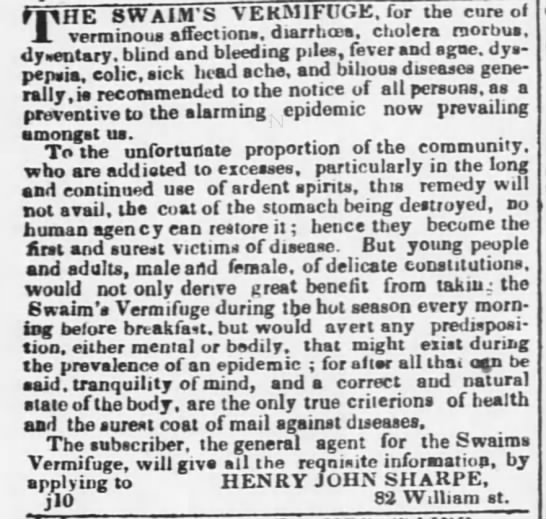
I was also interested in "Swaim's Wormifuge," which sounded like all sorts of wrong spelling. Turns out, this actually existed as Swaim's Vermifuge (medicine that destroys worms???). William Swaim began production of his medicine in the 1820s, and from there published a book that recommended the use of his treatments. It has been suggested that he swiped the recipe from Dr. N.J. Quackinboss (really???), since apparently Swaim was a bookbinder by trade. No medical license hanging up on his wall.

The mixture included mercury, oil of wintergreen, and sarsaparilla. Poor Nancy Linton never stood a chance. But nice scarf, I guess?

Despite the fact that this was literally MURDER WATER, Swaim was worried others would try to replicate his special formula:

"But this medicine has yet another class of enemies who it is to be feared may or have effected more practical injury to the public than the other as their bold pretensions may deceive the ignorant. It consists of those apothecaries and others who admitting Mr Swaim's title to the original discovery advertised that they have attained the knowledge of his secret." (2)

Swaim made a ton of money from the mixture, despite many doctors recommending against it. His son continued the business and it was sold into the 1920s. You can go on ebay today and find people selling the bottles. I have to admit, they are pretty bottles, even if they sold death juice.

New York, 10 Jul 1832

You are very clever, Eliza Leslie!
The tin man was our villain from the beginning, despite his promises of scallop-edged pie tins.

The moral of this story, I've gathered, is that a quack deserves what punishment he receives. Certainly the crime of kidnapping a child and attempting to sell her into slavery earned the shady tin man his fines and imprisonment. However, the moment I discovered he was selling his own special brand of homemade medicine, I know the guy was terrible. Quacks still exist today, with their stupid diet pills and even more ridiculous juice cleanses that claim to heal organs. NOPE.

Overall, taking a closer look at a tiny portion of this Eliza Leslie's writing yielded a ton of research about the 19th century, and helped me to better understand the time period. Perhaps my next working impression will be that of a quack, peddling my "medicine" to the unsuspecting buyer.

Or I'll just buy some pie tins.

~Kristen

(1) A Pure Mind in a Pure Body, that is Health. A new system of health and medicine.

(2) A Treatise On The Alternative And Curative Virtues Of Swaim's Panacea, And For Its Application To The Different Diseases Of The Human System: ... Its Pharmaceutic Effects As A Remedial Agent

(3) Swaim's Panacea

(4) Selections from Eliza Leslie

Wednesday, August 28, 2019

The First Day of School!

For some reason every year, summer ends. I'm left with the startling realization that I have a job to return to, one filled with endless lesson plans and my sincere hope that the kids learn to love to read. Today was my first day, starting my TENTH year of teaching!

And while the classroom certainly feels different on the other side of the teacher's desk, I'm reminded of the hustle and bustle of my own high school career. It feels amazing to look at young people and help them in any way that I can. For some of my students I play parent more than they see at home. It's a privilege to stand at the front of my classroom and teach. 

I found a snippet from a 19th century magazine, one that inspires me to continue my career:

Godey's Lady's Book, February, 1859
One week later, Jessie awaited, with a fast-beating heart, the arrival of her first class. It was very small. One little girl only had summoned up courage to come. Her report was so favorable that, the next day, three little girls and two boys came; and, in the course of the month, the room was filled each day. There was something in the pale, pure face and slight frame of the teacher that awed the class at first, then won their respectful love. No profane word ever fell upon the ears of the young girl. Errors to correct she found in plenty; but, with a low, sweet voice, and that indescribable holiness that encircled her, she drove away all impiety, all profanity. Rough boys went home with their minds filled with higher ambition and purer thoughts than they had ever before felt. Girls bent to her, at their departure, with their mind, blessing the sweet, gentle teacher who had won them from ignorance, perhaps from vice. And so passed her life. Trials she had among her class; but, with gentle patience, she made rough places smooth. Some ingratitude, too, came to trouble her; but she never failed in her efforts. It is now thirty years since Jessie Harris fell down the quarry; and if, in passing through Snowdonville, you ask who is the most useful and best-beloved person in the village, they will point out a little cottage, and tell you its occupant, Jessie Harris, fills the place. Mrs. Harris is dead; George is a lawyer in the South; and Jessie lives alone, excepting her maid, one of her old scholars, who almost worships her mistress. Gentle, meek, and hopeful, she lives an example that none are so unfortunate that they can be of no use in the world.

I hope for a good school year for all students and educators. Good luck, and happy learning!

~Kristen

On My Bookshelf: December

December has been a really rough month. Between what happened in Oxford (not far from where I live...) and just the general pandemic issues,...